Min. 100 units · 3–5 days
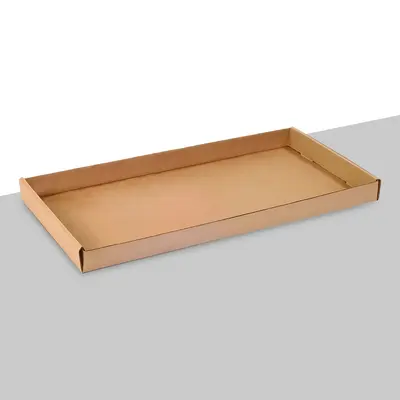
Cardboard Catering Trays
Custom Food Trays
Specify thisCustom Food Packaging
Custom catering Boxes produced to your size and substrate, with printing and finishing handled in one run.
No obligation
Name, email, phone and what you are packing and the finish you have in mind. Attach artwork if you have it. We reply with a specification and a written price, usually within one business day.
Base rigidity across the long span decides everything. Corrugated or a laminated base is usually needed; a folding carton grade will not hold.
Catering Boxes are built from greyboard wrapped in a printed or specialty paper, assembled by hand so the walls stay rigid and the lid holds its shape.
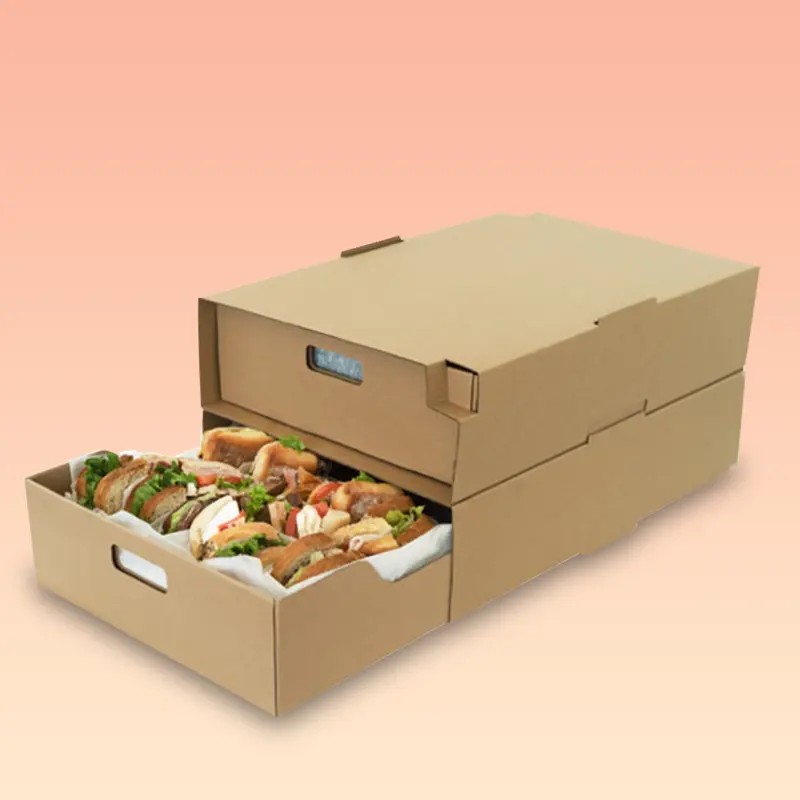
Catering Boxes hold a full platter order — sandwiches, wraps or hot trays — carried to an office or venue. That is the starting point for the specification, because base rigidity across the long span decides everything. Corrugated or a laminated base is usually needed; a folding carton grade will not hold.
In service they are used for office deliveries and event drops where one person carries a loaded box some distance.
Catering Boxes are specified for office deliveries and event drops where one person carries a loaded box some distance. Base rigidity across the long span decides everything. Corrugated or a laminated base is usually needed; a folding carton grade will not hold.
Where a product needs to be held still, a fitted insert cut to its profile does more for damage rates than a heavier outer board. It usually costs less too, because you can drop a grade on the outer.
B-flute corrugated or a laminated base. A folding carton grade will not hold an 18 in span under a full platter.
The options we would consider for this format are below; base rigidity across the long span decides everything. Corrugated or a laminated base is usually needed; a folding carton grade will not hold.
Large footprints, commonly 18 × 12 × 3 in through 22 × 14 × 4 in, and always shallow relative to their span.
Send the contents rather than a box size. Buyers judge a catering box by how it looks closed, and never test lifting a full one by the ends, which is how it is always actually carried.
The base flexes and folds in the middle when lifted from the ends, tipping the contents against one another.
Paperboard also absorbs moisture from the air until it equalises with its surroundings. If stock sits more than about six weeks in unconditioned space, a moisture-resistant coating is worth its small premium.
Flexo on corrugated rather than offset — at this size and quantity, litho lamination rarely earns its cost.
The finishes below are quoted line by line. Each is an additional pass, so dropping one is a real saving rather than a rounding difference.
Foil, soft-touch and deboss all read differently in person than on a screen, so we recommend a printed prototype rather than a digital proof alone for anything finish-led.
Sample costs are normally credited against the production order.
Tell us what goes inside, how many you need and when. Those three answers are enough for us to specify and price the job properly.
A dieline template follows, then a proof. For finish-led work we usually recommend a physical prototype at this point, because foil and soft-touch do not read accurately on screen.
Buyers judge a catering box by how it looks closed, and never test lifting a full one by the ends, which is how it is always actually carried.
The rest of these come up often enough across the format to be worth stating plainly.
Reference
| Product | Catering Boxes |
|---|---|
| Category | Custom Food Packaging |
| Construction | Hand-wrapped rigid greyboard |
| Board thickness | 1.5 mm – 2 mm greyboard |
| Ships as | Pre-assembled, nested where possible |
| Materials | 1200gsm greyboard with printed wrap, 1400gsm greyboard, Specialty textured wrap paper, Linen-finish wrap |
| Printing | Offset-printed wrap, Digital-printed wrap, Screen printing on wrap |
| Finishes | Foil stamping, Embossing, Debossing, Soft-touch lamination, Spot UV |
| Minimum order | Minimum order is 100 units on any format, and unit cost falls sharply as the quantity rises. |
| Lead time | 3 to 5 business days after artwork approval |
| Shipping | Across the US, UK, Canada and Australia |
Specification builder
Set what you know, leave the rest. Everything here travels with your request, so nothing gets retyped.
Drag to rotate
In practice
Large footprints, commonly 18 × 12 × 3 in through 22 × 14 × 4 in, and always shallow relative to their span.
The base flexes and folds in the middle when lifted from the ends, tipping the contents against one another.
Specified for office deliveries and event drops where one person carries a loaded box some distance.
Base rigidity across the long span decides everything. Corrugated or a laminated base is usually needed; a folding carton grade will not hold.
This format sits in our custom food packaging range, alongside 33 other made-to-order formats.
Answers
Specification, minimums and lead times for catering boxes.
Only if the base is specified for the span. A shallow box 18 in or more across flexes badly when lifted by the ends, which is how they are actually carried. Send the loaded weight and we will grade the base for it.
We specify food-contact compliant boards and inks where the pack touches food directly. Tell us whether contact is direct or through a liner for catering boxes, because it changes which stocks are available to you.
A grease-resistant coating or a greaseproof liner. Untreated board will always strike through eventually with hot, oily food — that is a property of the material rather than a quality fault, and it is inexpensive to design out.
Rarely without compromise. A box built to present is not built to survive a carrier network alone. A presentation box inside a plain protective outer usually costs less overall than one box trying to do both.
Because they are hand-assembled rather than machine-glued, and because the wrap, corner finish and interior lining are each separate operations. They also ship assembled rather than flat, which raises freight. The trade is a structure that feels substantially different in the hand.
Ones that read from arm’s length. Soft-touch lamination and deboss change how the whole pack reads; a small foil detail often does not survive the distance between shelf and eye. We quote each pass separately so you can judge.
Yes, which is part of why their freight cost is higher than a folding carton. Collapsible rigid constructions exist and ship flatter, at some cost to the feel of the finished box.
Yes. Once a first run is approved we hold the board, structure, dimensions, print method and finishes against your account, so a reorder references the same specification exactly rather than being re-derived. That includes the ink formulation, which is what keeps a brand colour consistent between runs rather than drifting a shade each time.
Recycled grades are available across most of the substrates we run for rigid boxes. Recycled content, kerbside recyclability and certified compostability are three different claims though, so tell us which one you intend to print.
A print-ready PDF or a vector file, with fonts outlined and any raster images at 300 dpi at final size. We supply the dieline to design onto, and prepress checks bleed, safe area and crease clearance before issuing a proof. A wrapped box needs bleed carried around the turn-in as well as the visible face, which is more artwork area than the outside dimensions suggest.
A flat 100 units on any format. Most rigid boxes in this range are quoted from 100 units upward because unit cost falls sharply above that, but the minimum exists so you can validate a structure first.
3 to 5 business days after artwork approval, plus freight. Rigid box runs with applied finishes can take longer because each finish is a separate pass, and we confirm a firm date in writing with the quote.
Related formats
Next step
Send the fill size and the volumes you run. We reply with a full specification and a written price, usually within one business day.