

Min. 100 units · 3–5 days
9 made-to-order formats
The cavity that holds a device still is doing almost all the work. Once the contents cannot move, the outer rarely needs to be heavier than a standard grade.

Devices and accessories are rarely regular shapes, and the cavity has to follow the object rather than approximate it. Send drawings or, better, a sample — irregular geometry is difficult to capture accurately from a technical drawing alone.
Cable management is part of the same problem. A coiled cable that has nowhere to sit will push against the device and mark it, which is the most common electronics packaging complaint we are asked to solve.
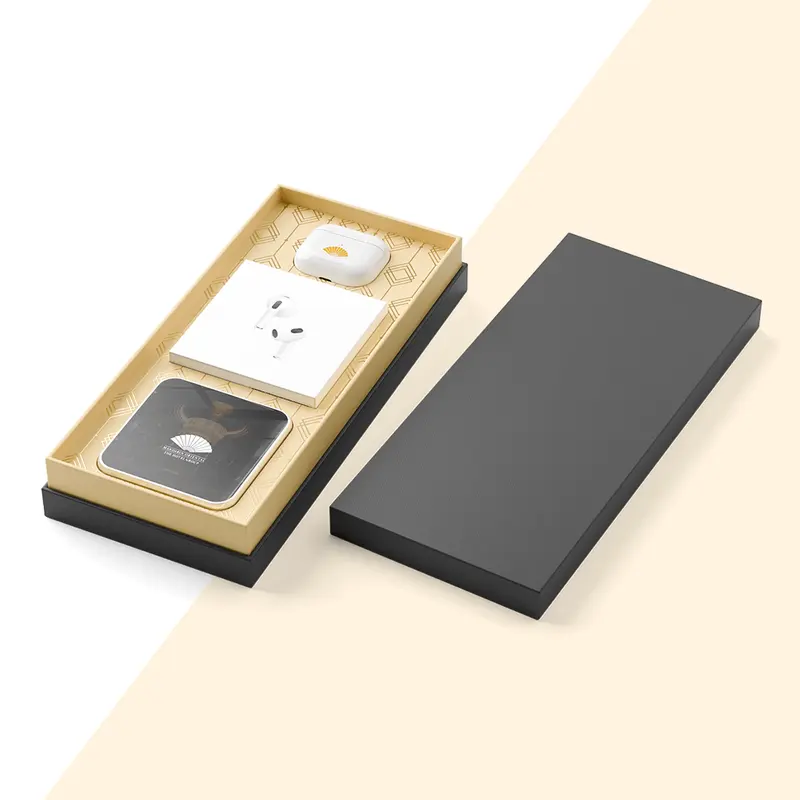
In consumer electronics the opening sequence carries genuine brand weight — what the customer sees first, what lifts out, what is revealed underneath. That is a layered insert decision, not a print one.
It also conflicts slightly with pure transit protection, which wants everything gripped tightly. Deciding which layer serves which purpose early avoids a compromise that does neither well.
What each cushioning approach gives you.
| Material | Protection | Presentation |
|---|---|---|
| Die-cut board insert | Moderate | Good — clean and printable |
| Foam insert | Highest shock absorption | Functional, less refined |
| Moulded pulp | Good | Natural look, recyclable |
| Board tray with foam layer | High | Best of both, higher cost |
The range
No format matches that. Try a shorter word, or describe what you need in a quote request.
Specification
Component count. Every cable, adapter and manual needs a home or the pack looks disorganised on opening. Our guide to packaging board and film grades compares them on strength, print quality and cost.
Run length usually decides this. Digital wins on shorter quantities because there is no plate cost; beyond that, offset and flexo overtake it on price per unit.
Finishes are applied in the same production run. Each one adds a step, so we price them individually rather than bundling them into the base rate.
Most orders here come from electronics and hardware, e-commerce and dtc, retail and grocery brands.
Specification builder
Set what you know, leave the rest. Everything here travels with your request, so nothing gets retyped.
Drag to rotate
Recent work
The electronics work we quote most.
Get a price
Send the product details and the quantity you have in mind. We reply with a specification and a written price, usually within one business day.
Prices start from $0.30 per piece for large-volume orders. Final pricing depends on size, material, printing, finishes, and quantity.
No obligation
Send us the product details and quantity. We reply with a specification and a written price, usually within one business day.
Answers
A cable or accessory with nowhere to sit, pressing against the device and marking it. It is a cavity layout problem rather than a protection one, and it is entirely avoidable.
A sample, if possible. Irregular geometry is hard to capture accurately from a drawing, and a cavity that is a millimetre out either grips too hard or lets the device move.
Board for light and regular items and for presentation, foam for fragile or irregular items needing shock absorption, moulded pulp where recyclability matters. Many device boxes use a board tray over a foam layer.
We can specify boards and liners appropriate for electronics handling. Tell us the exact requirement your process operates under, since it varies considerably by component type.
Decide what the customer sees first, what lifts out and what is underneath, then build the insert layers to that. It is a structural decision made before any artwork.
Usually not, once the insert holds the contents still. Most electronics damage is movement inside an intact box, so the cavity does the work and the outer only has to resist crushing.
Yes, including hang tabs and window apertures. Tell us if the box is faced on a peg or on a shelf, because the strongest panel should be the one on show.
A flat 100 units on any format, which is enough to validate a cavity against real handling before a production commitment.
Board and moulded pulp both are. Foam generally is not through kerbside collection, so if recyclability is firm we would steer toward pulp and accept slightly less shock absorption.
From $0.30 per piece at large volumes for simpler formats. Multi-layer inserts and foam sit above that, and the right comparison is against the value of the device they protect.
Related ranges
Next step
Send the product dimensions and the quantity you need. We come back with a specification, a lead time and a written price.