Packaging resources
Packaging Finishes Guide
Laminations, coatings, spot UV, foil, embossing and windows compared on what each achieves, what it costs per pass and where it disappoints.
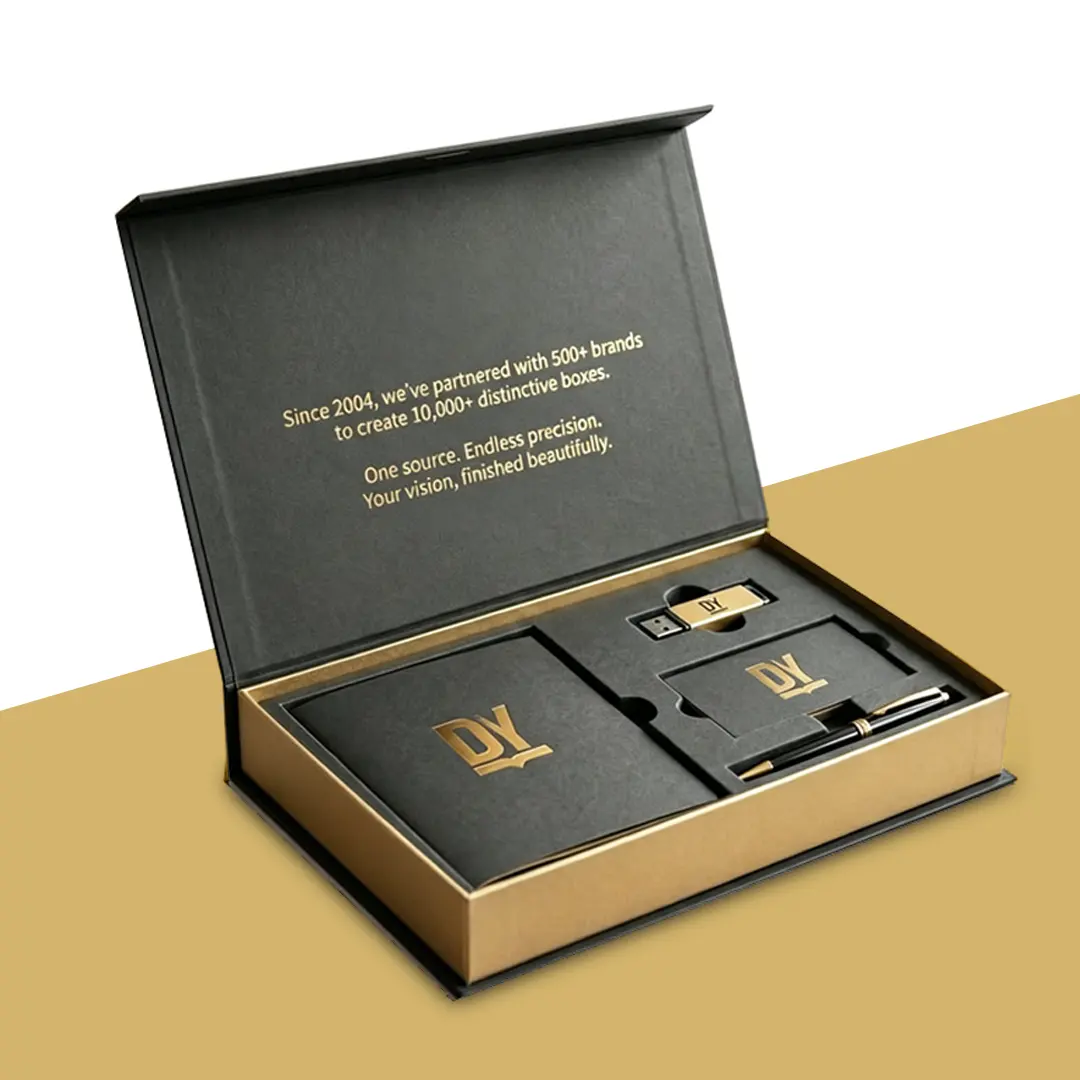
Every finish is a separate production pass with its own cost. Understanding what each one actually does prevents specifications that layer three effects competing for attention.
Laminations
A thin plastic film bonded to the printed sheet.
| Type | Effect | Best for | Watch out |
|---|---|---|---|
| Matte | Non-reflective, soft | Packs handled in store | Shows scuffing less, colour slightly muted |
| Gloss | Saturated, reflective | Vivid photography | Fingerprints visible |
| Soft-touch | Velvet texture | Premium feel | Shows marks more than matte |
Lamination adds durability and moisture resistance, but a plastic laminate makes paper packaging harder to recycle in standard streams.
It also changes colour. Matte laminate mutes and slightly darkens a printed sheet; gloss deepens and saturates it. On a brand colour that matters, approve the proof laminated rather than bare, because the difference is visible.
Coatings
Applied inline rather than as a separate film.
Aqueous coating is water-based, gives scuff resistance and keeps the pack recyclable as paper. It does not match lamination for gloss or barrier.
UV coating cures under ultraviolet light and gives higher gloss than aqueous. Applied as a flood or as spot UV.
Grease-resistant coatings are essential for food-contact board. PE-free versions now perform well for short contact times.
Spot UV
High-gloss varnish applied to selected areas only. Its entire effect comes from contrast, so it works over matte lamination and is close to invisible over gloss.
Needs its own screen and pass. Register tolerance means very fine spot UV detail can shift slightly against the underlying print.
The strongest use is on an element that is already doing work — a logo, a product name, a single graphic device. Spot UV scattered across several elements dilutes the contrast that makes it effective.
Foil stamping
Metallic foil applied by a heated die. Requires a die, which is a one-time tooling cost.
Reproduces bold shapes cleanly and fine detail poorly, because the die crushes thin elements. Simplify the mark before stamping rather than after seeing the result. Works well on both coated and uncoated stocks.
Foil is available well beyond gold and silver — matte metallics, coloured foils and holographic effects are all standard. A matte foil on an uncoated stock reads very differently from a bright gold on gloss, and it is worth seeing samples before assuming foil means shine.
Embossing and debossing
Embossing raises the board; debossing recesses it. Both need a die.
Artwork must be designed for relief from the start. Applying an emboss to a logo drawn for flat print usually produces a soft, indistinct impression. Combining emboss with registered foil is achievable but a more demanding setup.
Board thickness limits depth. A 14pt carton takes a shallow impression; rigid greyboard takes a much deeper one. Asking for a pronounced emboss on a thin stock cracks the surface at the edges of the impression.
Windows
A die-cut aperture with film applied behind it. PET is standard; PLA is available for compostable specifications, though it is less clear.
Windows weaken the panel slightly, so placement matters on structural faces.
They also need positioning against the product rather than the panel. A window centred for visual balance frequently shows the customer the side of the product, or an empty gap above the fill line.
Cost behaviour
Finishes with dies — foil, emboss, deboss — carry a one-time tooling cost plus a per-unit pass cost. Finishes without dies — laminations, coatings — carry only the pass cost.
That means die-based finishes look expensive on short runs and reasonable at volume, while laminations cost broadly the same per unit at any quantity.
| Finish | Tooling | Per-unit | Best value at |
|---|---|---|---|
| Matte or gloss lamination | None | Low | Any quantity |
| Soft-touch lamination | None | Moderate | Any quantity |
| Aqueous coating | None | Very low | Any quantity |
| Spot UV | Screen | Low | Mid to high volume |
| Foil stamping | Die | Moderate | Volume, or small marks |
| Emboss or deboss | Die | Moderate | Volume |
What goes wrong
Three finishes competing. Foil, spot UV and emboss on one panel each fight for the same attention and the pack reads busy rather than considered. One dominant finish almost always looks more expensive than three.
Specifying for a photograph rather than a shelf. Fine foil detail and delicate emboss photograph beautifully at 200mm and disappear at arm’s length. Decide which distance matters for your product.
Finishing a surface nobody sees. Spot UV on a base panel, foil under a sleeve, emboss on a face that ships against another box — all paid for, none seen.
Leaving finish decisions until after artwork. Emboss, foil and spot UV all need artwork prepared specifically for them. Retrofitting them to a finished design is where the disappointing results come from.
Choosing
Ask what job the finish does: protection, contrast, texture or perceived value. If it does not have one, it is decoration you are paying a production pass for. One well-chosen finish generally reads as more considered than three competing effects.
Structural extras behave differently from surface finishes — the options that change how a pack functions are set out in our guide to packaging inserts and internal structure.